The client operates in the infrastructure and heavy engineering domain, where multiple departments manage contracts, vendor communication, material logistics, and financial tracking. Most of these workflows were being handled through siloed legacy systems, emails, or spreadsheets—leading to poor coordination and lack of visibility.
The objective was to design a centralized platform that brings transparency, efficiency, and clarity across departments - Procurement, Finance, Engineering, and Contracts. The teams faced several operational roadblocks: Enquiries were scattered across email threads, making it hard to track vendor responses. Contracts lacked a single source of truth, with multiple versions shared over time. Finance teams had no visibility into real-time utilization or pending payments. Material movement updates were handled offline, delaying decision-making. Users found the existing tools unintuitive, with no clear navigation or structure
The Problem
The teams faced several operational roadblocks:
Enquiries were scattered across email threads, making it hard to track vendor responses.
Contracts lacked a single source of truth, with multiple versions shared over time.
Finance teams had no visibility into real-time utilization or pending payments.
Material movement updates were handled offline, delaying decision-making.
Users found the existing tools unintuitive, with no clear navigation or structure.
Users
We identified four primary user groups:
Procurement Managers responsible for sending enquiries and finalizing vendors
Project Engineers who track deliveries and manage day-to-day execution
Finance and Accounts Teams who oversee budget allocation, invoicing, and consumption
Contract Admins who manage documentation, terms, and renewal cycles
Each user group had different needs, but the goal was to unify the experience across modules.
UX Approach
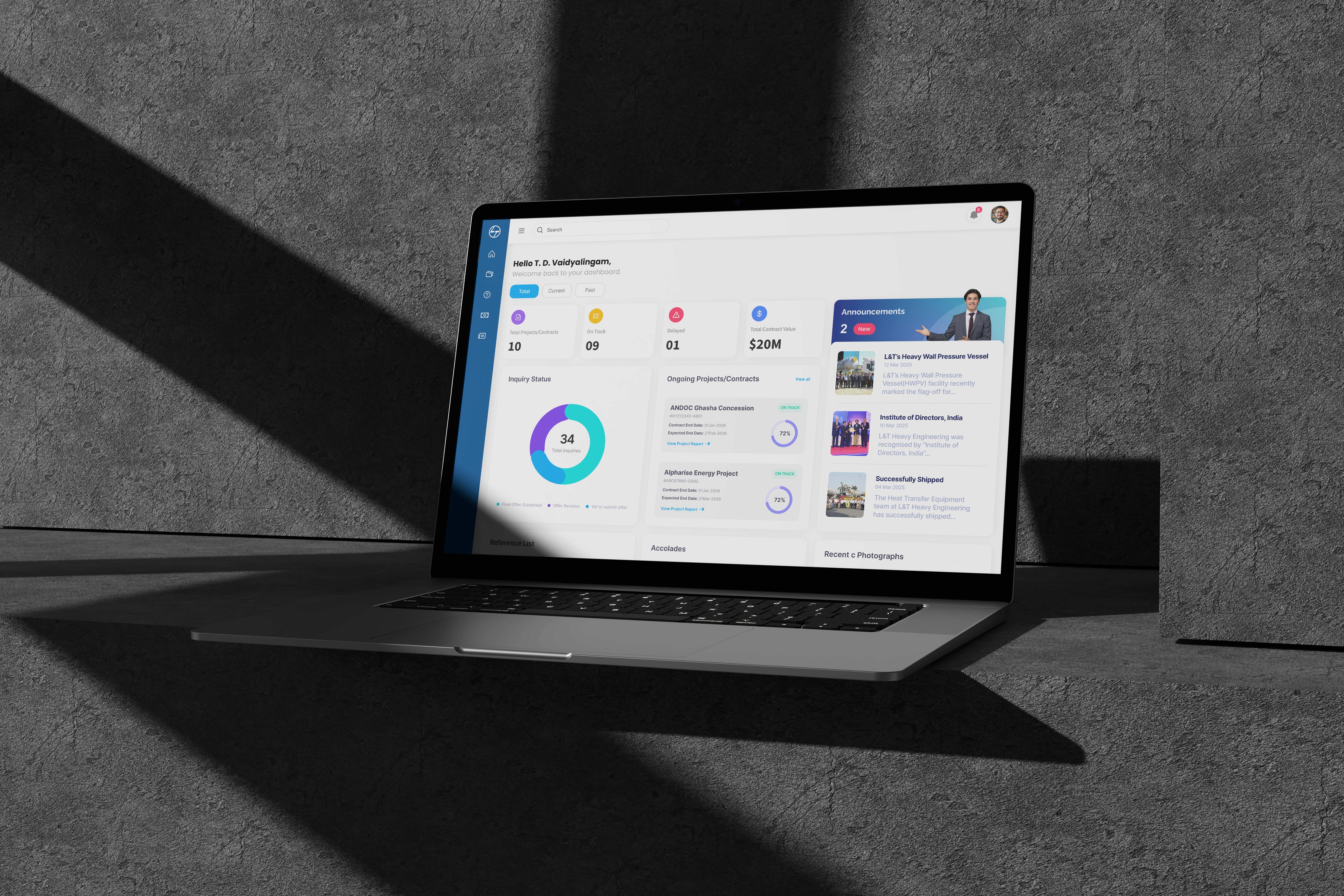
To address the complexity, we divided the platform into 7 key modules based on real-world workflows:
Enquiry – Users can create, manage, and send out RFQs (Requests for Quotation) to vendors.
Enquiry Details – A vendor comparison view that helps evaluate quotations and responses.
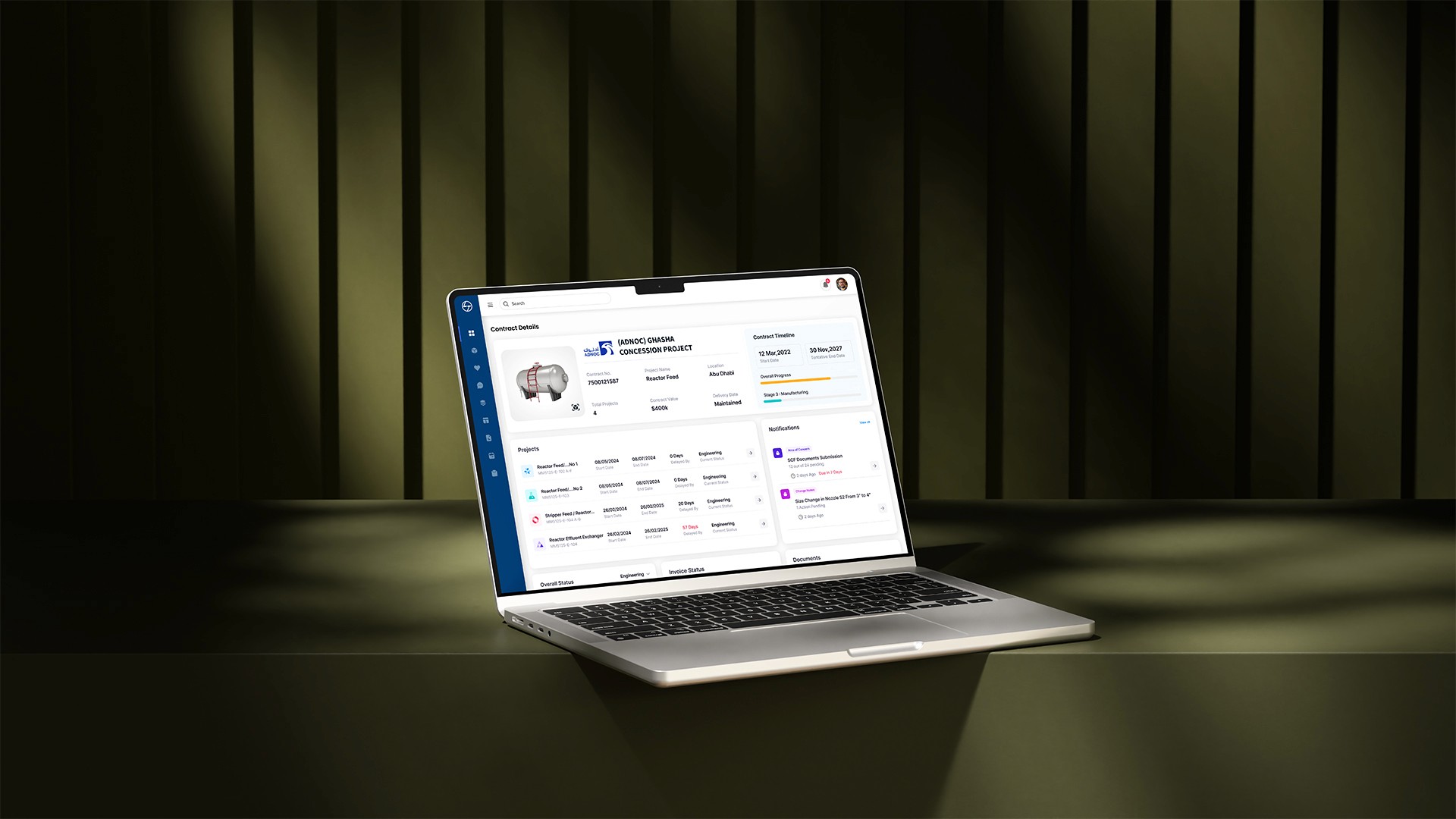
Contract Details – A centralized page where every contract’s lifecycle, milestones, and status can be tracked.
Financial Overview – Displays total contract value, remaining balance, and invoicing timelines in a simple visual layout.
Material Status – Lets users monitor dispatch, delivery, and material handover updates.
My Contracts – Allows users to search, bookmark, and manage both current and historical contracts.
Reference Listing – Helps teams refer to older contracts for pricing benchmarks and documentation standards.
We designed a consistent UI structure: a left panel for high-level navigation, tabbed layout for sectioning details, and top-right CTAs for quick actions like download, edit, or share.
Design Approach
Some key design choices that helped streamline user experience:
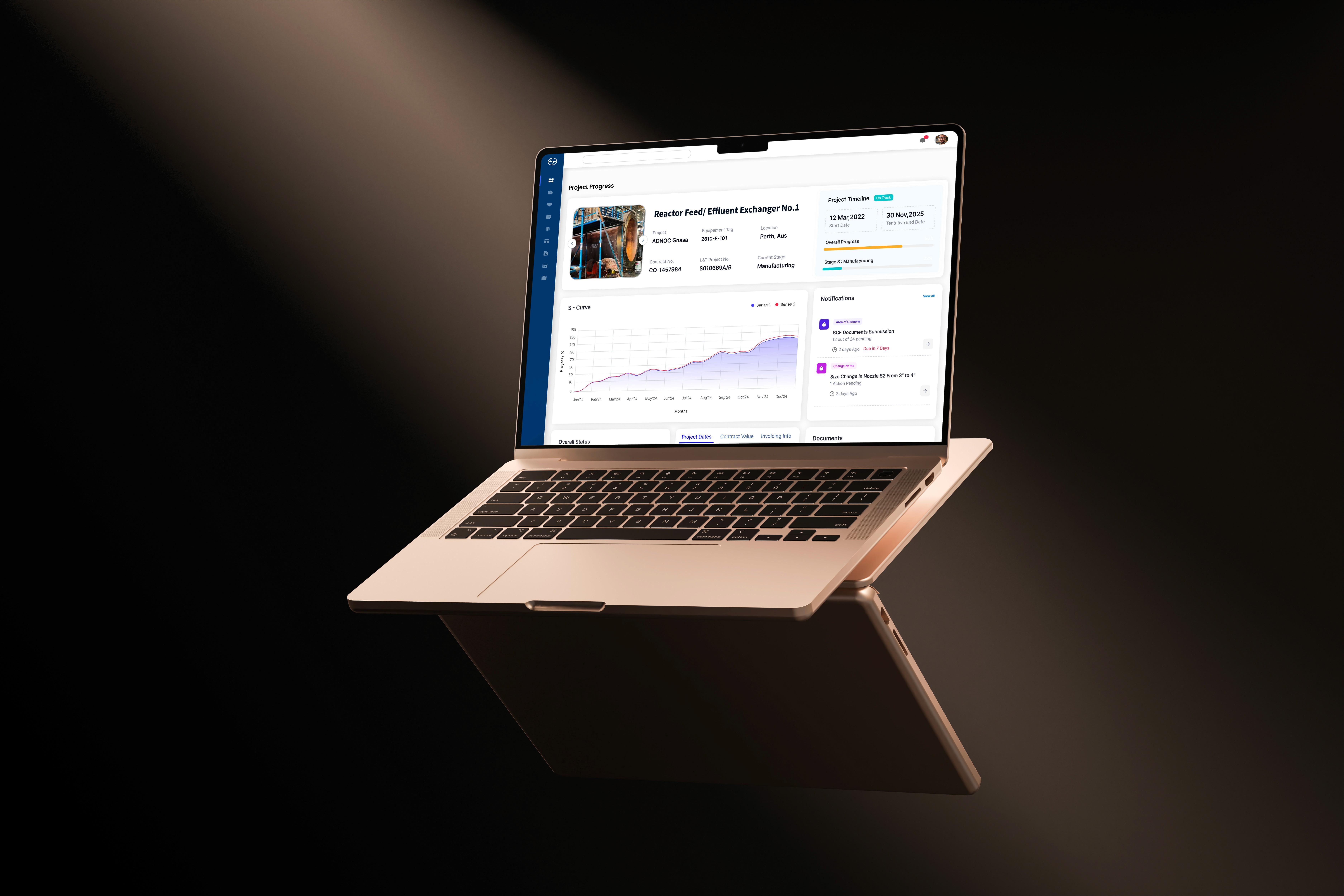
Progress Indicators were added in both Enquiry and Material modules to show current stage, pending actions, and completion percentage.
Tabular Views with Smart Filters allowed users to sift through vendors, contracts, or invoices easily—something Excel previously handled, but without structure.
Financial Graphs and Metrics provided finance teams with immediate visibility into consumption, dues, and upcoming approvals.
Information Tabs in the contract section separated complex data like Terms & Conditions, Deliverables, Amendments, and Notes—reducing information overload.
Status Highlights used color-coded alerts (e.g., red for delays or overspend) to guide user attention where needed.
The overall design stayed minimal and functional, with emphasis on hierarchy, legibility, and consistency across modules.
Outcome
The platform now offers a unified workspace where different teams collaborate without friction. Tasks that earlier required multiple tools—like tracking dispatches or validating vendor quotes—can now be done in one place.
The redesign improved:
Cross-departmental coordination
Decision-making speed
Accuracy in financial tracking
Vendor onboarding and performance visibility
Most importantly, the system is future-ready: scalable to new workflows and simple enough for new users to onboard without training.